In Hong Kong Street View the traffic is often easier to read than the street signs. Taxis, buses and minibuses all keep to
set areas, so recognising them rules out most of the map in seconds.
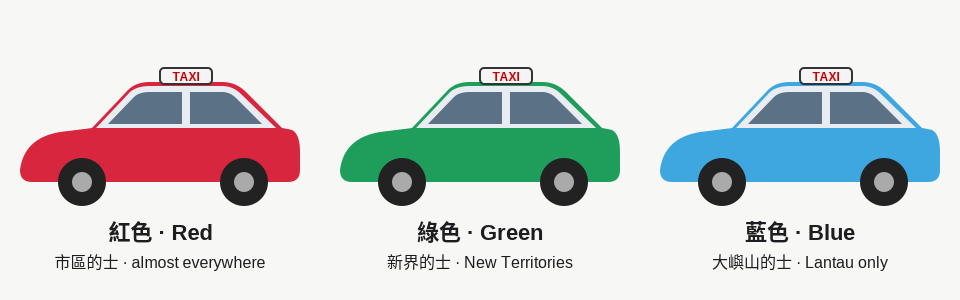
Taxis: red, green, blue
The three taxis: red urban taxis, green New Territories taxis and blue Lantau taxis.
Red (urban taxis): can go almost anywhere in Hong Kong, so a red taxi on its own tells you little about
where you are.
Green (New Territories taxis): only work in the New Territories and set parts of north Lantau, not in the
city on the island or in Kowloon. A green taxi usually means the New Territories.
Blue (Lantau taxis): only work on Lantau and at Chek Lap Kok. A blue taxi all but confirms Lantau.
Tip: red and green taxis in the same view often mean a New Territories town centre or an MTR station, where both kinds go.
Buses: the company and the route number
KMB: mostly Kowloon and the New Territories, but many cross-harbour routes are run jointly by KMB and
Citybus, so KMB buses are common on Hong Kong Island too.
Citybus: mostly Hong Kong Island, plus many cross-harbour routes and routes to Tung Chung and the airport.
Long Win: between Lantau (Tung Chung, the airport) and the city and the New Territories.
New Lantao Bus: within Lantau, to places such as Mui Wo, Tai O and Ngong Ping.
Route numbers follow patterns: cross-harbour routes are usually three digits starting with 1 (the Cross-Harbour Tunnel),
6 (the Eastern Harbour Crossing) or 9 (the Western Harbour Crossing). Routes starting with A are airport express buses, E routes
serve Tung Chung and the airport area, and N routes run overnight.
Minibuses: green roof or red roof
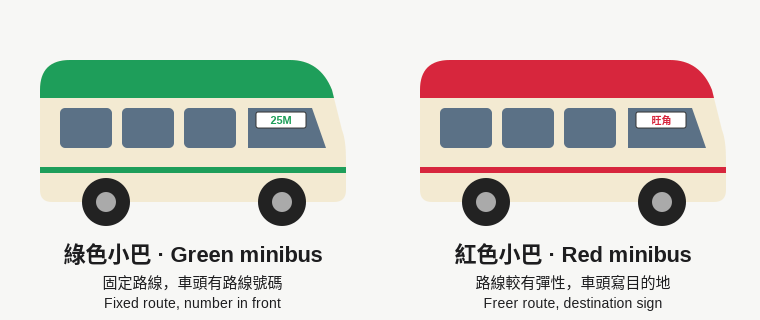
Green and red minibuses: look at the roof.
Green minibuses: a green roof, a fixed route, timetable and fare, and a route number on the front. Most
stay inside one district, for example from an estate to the MTR station.
Red minibuses: a red roof, freer routes and fares, and the destination written on a sign in the window.
Common in busy districts such as Mong Kok and Kwun Tong, and on longer routes to the New Territories.
Minibus stop signs and the boards in the windscreen often name a nearby place or estate. If you can read one, it may be the
best clue of the round.
Rail
Trams: only on Hong Kong Island's north shore.
Light Rail: only in Tuen Mun, Yuen Long and Tin Shui Wai.
MTR exits: a station's name and exit signs tell you exactly which station you are next to.
Try it: play a round now and watch the traffic in the next round.